My Thesis Broke and the Trade Still Made 38%. That Was the Plan.
In May I bought MagnaChip Semiconductor at $4.28. By mid-June the stock was near $8 and I sold half. A week later the company signed a $50M at-the-market offering agreement, which killed the entire reason I owned it, and I sold the rest at $3.81, below where I bought in. The round trip still closed up about 38%.
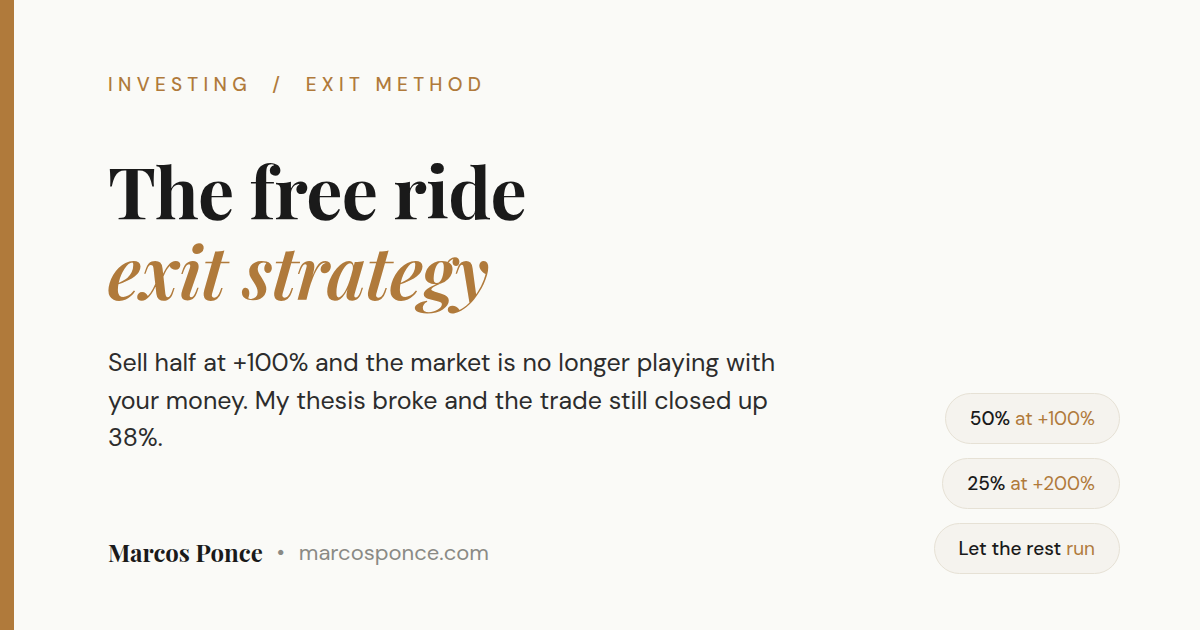
That result was not luck. It was the exit method doing exactly what it is designed to do, and the method is simple enough to state in one line: sell 50% of the position at +100%, sell 25% at +200%, and let the final 25% run. I call it the free ride exit strategy, because after the first sale you are no longer playing with your own money.
KEY FACTS
Sell 50% at +100%: that single sale returns your entire principal.
Sell 25% at +200%, run the final 25% with no fixed target.
Trim percentages apply to the ORIGINAL share count, decided before the trigger, never at it.
The method caps how wrong you can be after the first trim. It does nothing for you before it.
Stops give zero protection against overnight gaps. Trimming into strength is the only thing that does.
The arithmetic that makes it work
Buy $1,000 of a stock. It doubles. Sell half, and you are holding $1,000 of stock plus your original $1,000 back in cash. From that moment the position literally cannot lose you money. The stock can go to zero and you break even on the trade. That is the whole trick, and it is the reason the method changes behavior, not just outcomes.
Holding a volatile small cap on house money feels completely different from holding it on principal. You stop checking the quote at lunch. You stop negotiating with your stop loss. Every bad decision I have made in a position came from the fear of turning a winner back into a loser, and the first trim deletes that fear mechanically.
The second trim at +200% converts the trade into a locked profit of 1.5x your original stake, still with a quarter of the position running. The final quarter needs no target because it no longer needs anything. Speculative names get a 400% aspiration; nothing gets a deadline.
The MX trade, start to finish
The thesis was a deep-value turnaround: a semiconductor company trading near its cash value, a new power-semi product cycle, an activist filing, and directors buying in the open market. Entry May 15 at $4.28.
| Action | % of position | Price | What was happening |
|---|---|---|---|
| Entry | 100% | $4.28 | Cash-floor thesis, insider buys, activist 13D |
| Free-ride trim | 50% | ~$8.00 | Up 87%, slightly early, recovered ~93% of principal |
| Thesis breaks | — | — | June 17: company signs a $50M ATM sales agreement |
| Final exit | 50% | $3.81 | Below my entry. Round trip still ~+38% |
Read that last row again, because it is the entire argument. I exited below my own entry price and made money, because principal had come off the table before the bad news arrived. Full size through the same news is a losing trade. The security selection was mediocre. The structure was not.
The ATM signing is a hard rule in its own right, part of the dilution test: an authorization to sell shares is a watch item, a signed sales agreement is an exit. My honest post-mortem is that I treated the signing as news to evaluate instead of a trigger to act on, and the week of evaluating cost about $1.70 a share on the back half.
Trims are measured against the original position
A detail that sounds pedantic until the day it isn’t: the percentages apply to the original share count. Say a position is 150 shares: trim 75 at +100% and 37 at +200%, leaving 38 to run. If you instead sell half of whatever remains at each trigger, you are inventing a different, smaller-conviction system on the fly, at the exact moment you are least qualified to design one.
I resolved that question in my notes before it ever mattered in a live trade. Decide the mechanics while the trigger is 30% away and it is arithmetic. Decide at the trigger and it is a negotiation with yourself, and you will lose.
What the free ride does not do
It does nothing before the first trim. From entry to +100% you are fully exposed, which is what stop losses are for, and stops have their own honest limitation: a stop is a market order once triggered, so it offers zero protection against an overnight gap through it.
I got a live lesson in this holding a med-device position into an earnings print at a 52-week high. The stock gapped up 17% and ran on. Good outcome, and I recorded it in my journal as exactly that: a good outcome, not a validated process. The same setup gaps down 17% in a parallel universe and the stop does nothing. Trimming into strength is the only mechanism that actually caps gap risk, which is one more reason the first trim is not optional when the trigger prints.
The method also will not make you money on stocks that never double, obviously. It pairs with an entry discipline that only takes setups where doubling is arithmetically plausible, which is its own topic inside the framework.
Questions worth answering straight
Doesn’t selling half cap your upside? Yes, deliberately. The trimmed shares stop compounding and the remaining half plus the runner keep full exposure. I trade the tail of the upside for the certainty of never round-tripping a winner, and MX is what that certainty is worth in practice.
Why +100% and not +50% or +80%? Because at exactly +100%, selling half returns exactly your principal. The psychological transformation, playing with house money, only happens at that line.
What if the thesis breaks before +100%? Then the free ride never applies. A broken thesis is an exit at any price, and the stop handles ordinary drawdowns before then.
Is this the same as “letting winners run”? It is the disciplined version. Letting winners run with no trim plan usually means watching a +90% gain become +12% and then holding for the round trip out of spite.
Disclosure: I have no position in MX; the trade above is closed and logged on the live tracker. I currently hold DCTH, which is approaching its own first free-ride trigger, with the trim mechanics already written down. This is research and ideation, not financial advice. All trades carry risk of loss.
Stay in the loop.
No spam, just signal.
I send one email when I publish something worth reading. Stock deep dives, new projects, tech breakdowns, and what I'm learning from building in public.
Free forever. Unsubscribe anytime. I respect your inbox.