Not All Dilution Kills a Stock. I Built a Test for the Kind That Does.
Last summer I watched two small-cap companies sell new shares within weeks of each other. One raised at successively higher prices to fund a $103M backlog it had already signed, with revenue growing 109% against 6% share growth. The other signed a $50M at-the-market facility to sell stock into a falling price, for “general corporate purposes,” while revenue shrank. Both show up in a screener as the same thing: dilution. One was a company financing growth. The other was a company financing survival, and I was a shareholder of it at the time.
So the answer to the question in the title is: some dilution is fine, some is fatal, and you can tell them apart with a written test instead of a vibe. Here is the test I use, and the trades that validated it.
KEY FACTS
Dilution is excessive when shares grow faster than revenue, raises price lower each time, or proceeds have no named use.
Dilution is acceptable when each raise prices higher, revenue outgrows share count, and proceeds fund a signed backlog.
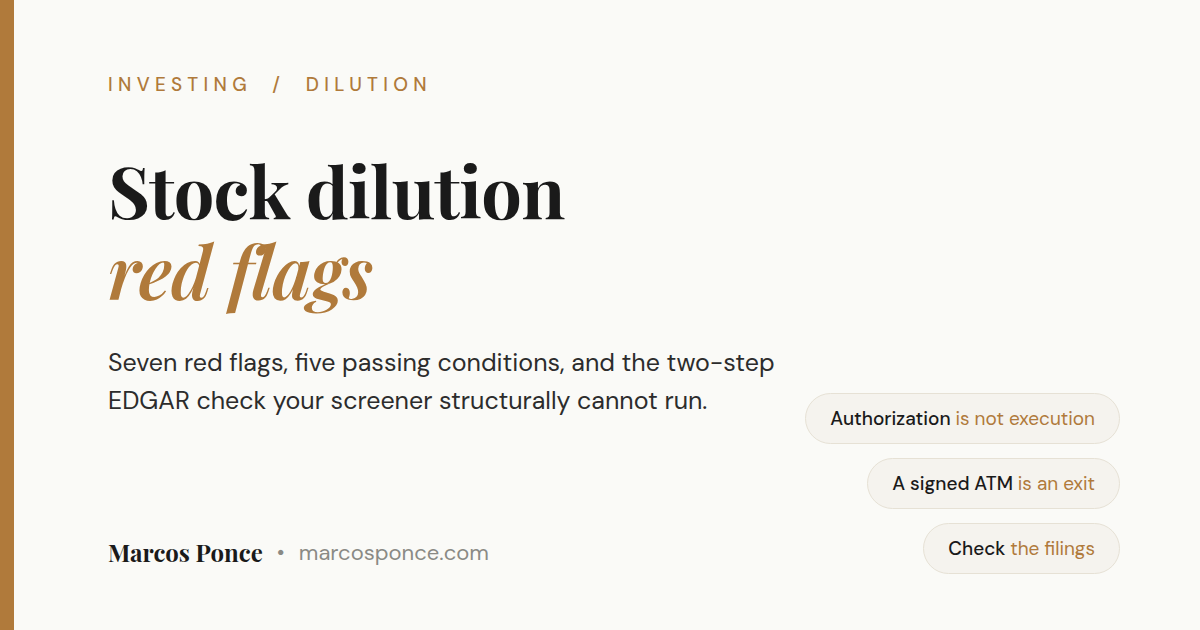
Authorization is not execution: an announced buyback means nothing until shares are actually repurchased, and a shelf filing is not yet dilution.
A SIGNED at-the-market sales agreement is an exit, not a watch item.
Screeners cannot catch this. The forward-looking evidence lives in EDGAR filings, not in share-count data.
Seven red flags that make dilution disqualifying
These are the stock dilution red flags I treat as disqualifying. Any one of them ends the analysis for me, regardless of the growth story attached:
1. Share count growing faster than revenue. The business can be expanding while your claim on it shrinks. One drone company I screened tripled its share count in a year against $17M of revenue. The chart went up; each share’s slice of the company cratered.
2. Successive raises at declining prices. Each round of investors is bailing out the last one at a discount. This trend does not reverse by itself.
3. An active ATM while the stock falls. An at-the-market facility lets a company drip shares into the market continuously. Doing that into weakness means management is selling their own stock down. This was the MagnaChip pattern, and it broke my trade.
4. Proceeds for “general corporate purposes.” Money raised with no named revenue-linked use is survival financing wearing a suit.
5. A reverse split within three years. A reverse split is the receipt for past dilution. Companies that needed one usually run the same play again.
6. Toxic structures. Variable-rate convertibles, death-spiral preferreds, warrant-heavy PIPEs. Securities that profit from the share price falling.
7. Earnings flattered by non-operating items while shares balloon. One name I eliminated printed a “profit” quarter that was entirely investment gains, while the operating business burned cash and the share count exploded.
Five conditions that make dilution acceptable
A raise passes only if it clears all five: each raise priced above the prior one, revenue growth exceeding share growth so the raise is accretive per share, proceeds tied to an identified and funded backlog or capacity expansion, a post-raise balance sheet with low debt and 24+ months of runway, and no reverse splits or toxic structures in the history.
The infrared optics company from my opening cleared all five. Selling shares was the correct decision for that business, and shareholders were better off for it. The test exists precisely so that sentence can be true sometimes.
Authorization is not execution
The most useful line in the whole test, and it cuts both directions.
A buyback announcement is not a buyback. I tracked a Chinese touchscreen micro-cap that authorized a repurchase and then bought back zero shares over two years while promoting the authorization. Meanwhile a med-tech spinoff I evaluated actually repurchased 2.7M shares for $8.7M, verified line by line in the 10-Q. Same headline, opposite realities. Only the executed one counts as a signal.
Symmetrically, a shelf registration is not yet dilution. A company filing a $120M shelf has bought an option, not exercised it. That is a watch item with a tripwire: the moment an ATM gets signed against the shelf, it converts to red flag three and the analysis ends.
Where is the line? Signing. MagnaChip filed its shelf on June 12 and I correctly logged it as a watch item. It signed the ATM sales agreement on June 17, and that was the day the position deserved to be closed. I took most of a week to act, which cost about $1.70 a share on the remaining half, a tuition bill I only had to pay once. The signed agreement is the company putting its hand on the lever. You do not wait to see them pull it.
The sneakiest version: a terminated ATM that isn’t good news
One RF-amplifier company terminated a $25M ATM facility and I initially credited it as the anti-dilution story, the inverse of MagnaChip. It wasn’t. A ~$21.9M rights offering was already in flight behind it, issuing about 4.4M new shares with a second tranche queued for later in the year. They had not stopped diluting. They had changed instruments.
The rule that survives this case: apply the test to total capital-raising activity, never to a single instrument. Companies know which instruments carry stigma.
How the test has scored
| Case | Pattern | Verdict |
|---|---|---|
| MX (MagnaChip) | ATM signed into a downtrend, general corporate purposes, revenue declining | Excessive. Exited. |
| Drone maker | Share count tripled on $17M revenue, profit from investment gains | Excessive. Eliminated. |
| Microdisplay maker | $56M raised, PIPE priced at $2.10, negative product gross margin | Excessive. Eliminated. |
| RF amplifier co | Terminated ATM, but a rights offering replaced it | Excessive. Eliminated. |
| Infrared optics co | Raises at rising prices, revenue +109% vs ~6% share growth, funded backlog | Acceptable. |
| Compound semi co | Secondary funding capacity expansion, customer prepayments | Acceptable on dilution. Failed a different rule. |
How to actually check, in two steps
Screeners are structurally blind here. Share-count data is backward-looking, and it would not have caught MagnaChip at all: the ATM was signed on June 17 and shares only started flowing later. The forward-looking evidence lives in filings, so the check is manual and takes about fifteen minutes.
Step one: pull the last two 10-Q cover pages and compare shares outstanding, printed on page one of every filing. That is the trailing dilution rate.
Step two: search the company on EDGAR for S-3, 424B5, and 8-K filings mentioning ATM, PIPE, or convertible preferred. That is the pipeline of dilution that has not hit the share count yet, which is exactly the part that gets you.
The dilution test is one dealbreaker among eight in my full trading framework. And the MX trade it grew out of, which managed to be net profitable anyway, is the story of the free ride exit method. For an example of what a filings-first read of one dilution-happy micro-cap looks like end to end, see the Datavault AI deep dive.
Common questions
Is all ATM financing bad? No. An ATM used sparingly at rising prices by a growing company is cheap, low-drama capital. An ATM signed while the stock falls, with no named use of proceeds, is red flag three. The instrument is neutral; the context convicts it.
How much share growth per year is too much? My working ceiling is share growth above revenue growth. A company growing revenue 80% can justify 10% share growth. A company growing 3% cannot justify much of anything.
Do warrants count as dilution? They are queued dilution with a trigger price. Count them in fully diluted share count, and treat warrant-heavy financings as red flag six.
Why not just avoid every company that raises money? Because in small-cap tech that filters out most of the honest growth stories too. Raising capital is what growing companies do. The test exists to keep the growth financings while refusing the survival ones.
Disclosure: I hold no position in any company mentioned in this post; my MX position was closed in July. This is research and ideation, not financial advice. All trades carry risk of loss.
Stay in the loop.
No spam, just signal.
I send one email when I publish something worth reading. Stock deep dives, new projects, tech breakdowns, and what I'm learning from building in public.
Free forever. Unsubscribe anytime. I respect your inbox.