SFX vs Flex ATX: which power supply fits a tiny case
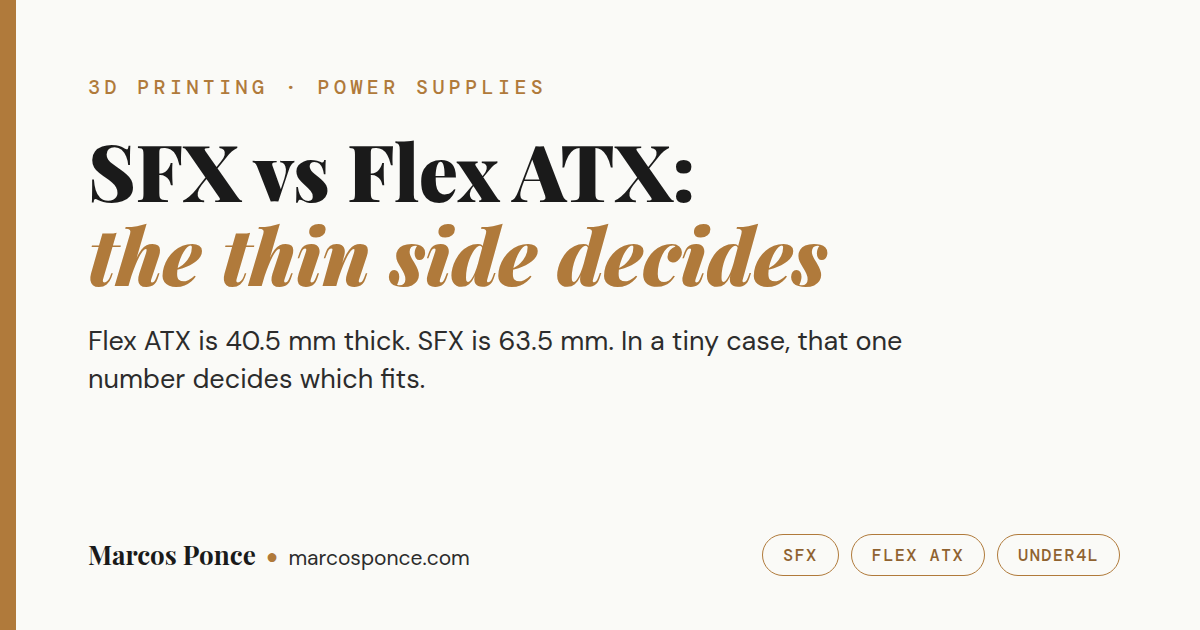
When I posted the Under4L to r/sffpc, one of the questions was whether it could take an SFX power supply. It can’t. The reason is a single number, and it is the same number that settles SFX vs Flex ATX in any case this small.
Short version for the skimmers. In SFX vs Flex ATX, the number that matters is the thinnest side of the box. A Flex ATX supply is 40.5 mm thick. The thinnest side of an SFX supply is 63.5 mm. If your case has a slot thinner than 63.5 mm, Flex ATX is the only option. If it has room for SFX, take SFX. You get a bigger fan and more wattage.
KEY FACTS
Intel’s power supply design guide puts a Flex ATX supply at 81.5 x 40.5 x 150 mm. That is about 0.50 L.
A standard SFX supply is 125 x 63.5 x 100 mm, about 0.79 L. SFX-L keeps the face and stretches the depth to 125 mm, about 0.99 L.
Flex ATX units cool with a 40 mm fan. SFX units use 92 mm and SFX-L units 120 mm.
The Under4L’s supply slot is 41.2 mm thick. A Flex ATX unit clears it by 0.7 mm. An SFX unit misses by 22.3 mm on its thinnest side.
SFX reaches 1000 W in the Corsair SF1000. The Flex ATX unit I checked, the SilverStone FX600 Platinum, is 600 W.
What is the difference between SFX and Flex ATX?
Both are small power supplies for small cases. They are small in different directions. SFX is a short, fat box. Flex ATX is a long, thin one. Here are the two, plus SFX-L, from the makers’ own spec sheets.
| Form factor | Size (W x H x D, mm) | Volume (L) | Fan | Example unit | Example wattage |
|---|---|---|---|---|---|
| SFX | 125 x 63.5 x 100 | 0.79 | 92 mm | SilverStone SX750 Gold | 750 W |
| SFX-L | 125 x 63.5 x 125 | 0.99 | 120 mm | Corsair SF1000L | 1000 W |
| Flex ATX | 81.5 x 40.5 x 150 | 0.50 | 40 mm | SilverStone FX600 Platinum | 600 W |
The SFX row comes from SilverStone’s SX750 Gold product sheet, which calls it the standard SFX form factor. The Flex ATX row is the reference size from Intel’s ATX12VO power supply design guide. SilverStone’s own FX600 Platinum manual gives 150 x 82 x 40.5 mm for that unit, half a millimeter wider than Intel’s figure. The SFX-L row is the mini-itx.com listing for the Corsair SF1000L, because Corsair’s own SF1000L page did not print the dimensions when I read it.
By volume, Flex ATX is the smaller supply. It takes about 0.50 L against 0.79 L for SFX. In a 3.73 L case like mine, an SFX unit would eat 21% of the whole box by itself. A Flex ATX unit takes about 13%.
Why the thinnest side decides it
Volume is not what stops a supply from fitting. Shape is.
A case designer usually has one awkward gap left over after the motherboard and the graphics card are placed. In most tiny cases that gap is thin. You can rotate a supply any way you like, but you cannot make its thinnest side any thinner. For Flex ATX that side is 40.5 mm. For SFX it is 63.5 mm, and SFX-L shares the same 125 x 63.5 mm face.
So the question to ask of any case is not “how many liters is the PSU bay”. It is “what is the thinnest dimension of the gap”. If it is under 63.5 mm, the SFX vs Flex ATX decision is already made for you.
The length goes the other way. A Flex ATX unit is 150 mm long, which is longer than an SFX unit is wide. So a case built for Flex ATX needs a long slot, and some cases cap it. The Velkase Velka 3 caps the supply at 165 mm, as I noted in my round-up of Mini ITX cases under 4 liters.
Which one fits the Under4L?
Flex ATX, and only Flex ATX. Here is the case in the same table format I use on every case post.
| Case | Volume (L) | Max GPU length (mm) | Max GPU height (mm) | Max GPU thickness (mm) | Max CPU cooler (mm) | PSU form factor | Price (USD) |
|---|---|---|---|---|---|---|---|
| Under4L (V6 / Carry) | 3.73 | 182 | 69 | 40 | 37 | Flex ATX | 9.98 |
The Under4L gets under four liters by stacking the graphics card and the power supply in one column on the same side of the motherboard. That column is only as thick as the thinner of the two parts allows. The supply limit I designed for is 170 x 82 x 41.2 mm. Here is how the two reference units compare against it.
| Dimension | Under4L supply limit (mm) | Flex ATX, FX600 Platinum (mm) | SFX, SX750 Gold (mm) |
|---|---|---|---|
| Thinnest side | 41.2 | 40.5 (fits, 0.7 spare) | 63.5 (22.3 too thick) |
| Width | 82 | 82 (fits, nothing spare) | 125 |
| Length | 170 | 150 (fits, 20 spare) | 100 |
The Flex ATX unit clears every limit, with no room to spare on width. The SFX unit is shorter than the slot and much too wide, but width is not the problem. Even turned on its side, its thinnest face is 63.5 mm, and the slot is 41.2 mm. No rotation saves it.
Somebody on Reddit asked for an SFX version, and it is still on my list. It would not be a tweak. Adding 22.3 mm to that column pushes the whole case out, and the graphics card clearance I worked out in my GPU clearance guide would change with it. It would be a different case.
Is a 40 mm fan a problem?
It is the real cost of Flex ATX, so it is worth being plain about.
A 92 mm fan has about five times the frame area of a 40 mm fan. A 120 mm fan has nine times the area. A small fan has to spin much faster to move the same air, and fast small fans are the ones you hear. Both Corsair units I checked also list a zero RPM mode, so their fans can stop at low load.
I have not put a meter on a Flex ATX unit, so I am not going to give you a decibel number. The Under4L has no case fans of its own, so the supply is often the part you hear, and a quieter Flex ATX unit is worth paying a little more for.
How much wattage do you need in a case this small?
Less than people buy. The small case limits the graphics card long before the supply does.
The fastest card I found that fits the Under4L and is sold new in the US is a low profile RTX 5060, rated at 145 W. That is from the 300-card GPU dimensions dataset I keep. A 600 W Flex ATX unit leaves more than 450 W for everything else. That is a lot of headroom for a board that also has to take a 37 mm cooler.
SFX has the wattage lead at the top. Corsair’s SF1000 is a 1000 W SFX unit, and the SF1000L does 1000 W in SFX-L. In practice, the cases small enough to need Flex ATX also cap the graphics card low, so the wattage gap rarely matters there.
Where does SFX-L fit in?
SFX-L is SFX with 25 mm more depth. It keeps the same 125 x 63.5 mm face and uses the extra room for a 120 mm fan. If a case takes SFX with some length to spare, SFX-L is usually the quieter choice.
One thing I noticed reading Intel’s guide: SFX-L is not one of the SFX packages it lists. The SFX chapter covers a lower profile package, two top fan mount packages, the standard package and a PS3 package. That is one more reason you should check the case maker’s supply length limit rather than assume SFX-L support from an SFX label.
How to check a supply before you buy
Read the maker’s sheet, and read the labels as closely as the numbers.
SilverStone is a good example of why. Its SX750 Gold sheet writes 125 mm (W) x 63.5 mm (H) x 100 mm (D). Its FX600 Platinum manual writes L150mm x W82mm x H40.5mm. Same company, two orders. Intel writes the Flex ATX figure as 81.5 x 40.5 x 150, which puts length last. If you copy three numbers off a retailer page without the labels, you can easily compare a length against a width.
Then take the thinnest of the three numbers and check it against the thinnest dimension of the case’s supply slot. That one comparison answers the SFX vs Flex ATX question for your case. The other two only matter once it passes.
Which one I would pick
If the case takes SFX, I would take SFX, or SFX-L when the case has the length. The fan is bigger, the wattage goes higher, and the fit is simple.
If the case is built around Flex ATX, as both sub-4 liter cases I found that take a graphics card are, then there is no decision to make. Buy a Flex ATX unit that fits the length limit and pick the quietest one you can find. The noise is the price of the smaller box, and in a case this size it is the price I chose to pay.
FAQ
Is Flex ATX smaller than SFX?
By volume, yes. Intel’s reference Flex ATX size is 81.5 x 40.5 x 150 mm, about 0.50 L. A standard SFX supply is 125 x 63.5 x 100 mm, about 0.79 L. Flex ATX is longer, but much thinner.
Can I put an SFX power supply in a Flex ATX case?
Almost never. The thinnest side of an SFX supply is 63.5 mm, and a Flex ATX slot is usually built around a 40.5 mm thick unit. In my Under4L the slot is 41.2 mm thick, so an SFX unit misses by 22.3 mm in any orientation.
Are Flex ATX power supplies loud?
They tend to be the loudest part of a small build, because they cool with a 40 mm fan. An SFX unit uses a 92 mm fan with about five times the frame area. I have not measured one, so I will not give a decibel figure.
How many watts can a Flex ATX power supply deliver?
The SilverStone FX600 Platinum I checked is rated at 600 W. That is plenty for the cards that fit a sub-4 liter case. The fastest new card that fits my Under4L is an RTX 5060 at 145 W.
What is the difference between SFX and SFX-L?
SFX-L is 25 mm deeper than SFX, 125 mm against 100 mm, with the same 125 x 63.5 mm face. The extra depth makes room for a 120 mm fan instead of a 92 mm one, which usually makes it quieter.
Get the files
The Under4L is built around a Flex ATX supply up to 170 x 82 x 41.2 mm. It is two STL files, the skeleton and the shell, with an assembly guide and the screw and riser specs. The Under4L case files are on Gumroad for $9.98.
Stay in the loop.
No spam, just signal.
I send one email when I publish something worth reading. Stock deep dives, new projects, tech breakdowns, and what I'm learning from building in public.
Free forever. Unsubscribe anytime. I respect your inbox.