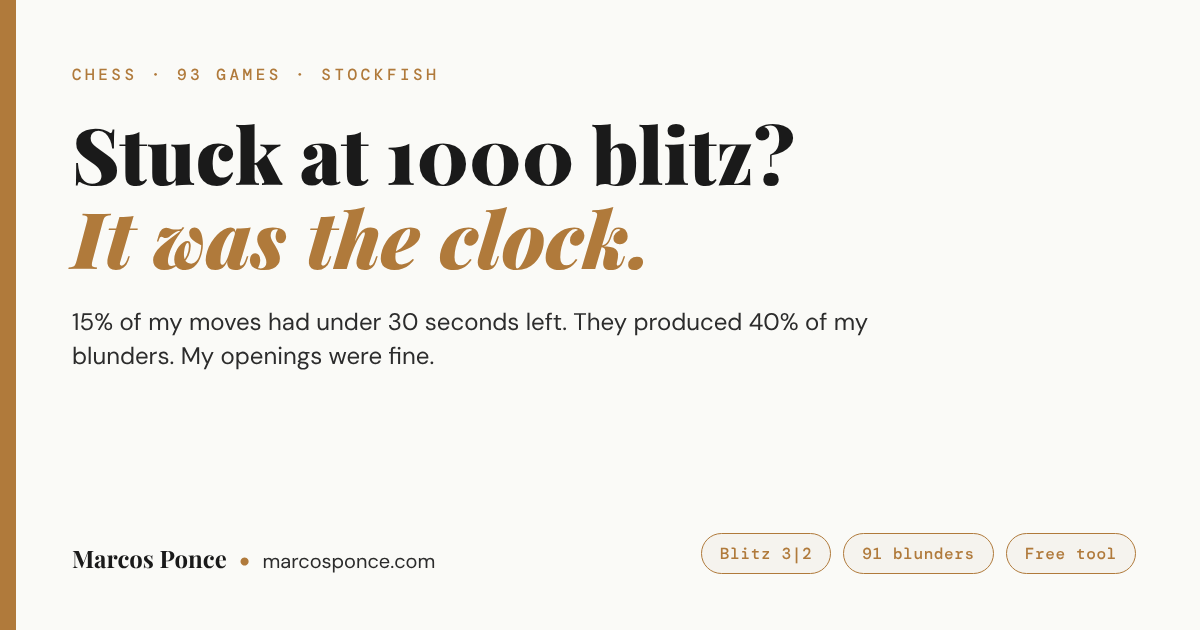
Stuck at 1000 blitz? I ran 93 games through Stockfish. It was the clock.
I have been stuck at 1000 blitz on Chess.com since the spring. Up to 1110, back down to 1030, up again. For most of that time I had a tidy explanation: my openings were thin. I play the Caro-Kann as Black and the London as White, I know maybe eight moves of each, and I figured a stronger player would be punishing me by move 12. So I watched opening videos. The rating did not move.
Short version for the skimmers. I pulled 93 of my own blitz games, ran every move through Stockfish, and sorted the blunders by how much time I had left when I played them. The openings were not the problem. The clock was. Only 15% of my moves get played with under 30 seconds on the clock, and those moves produce 40% of my blunders. I blunder on 8.2% of moves under 30 seconds and on 2.1% of moves with a minute or more. Same player, four times the error rate.
KEY FACTS
93 blitz games, Aug 4 to Sep 25, 2026, all 3|2. Record 45 wins, 47 losses, 1 draw. Rating 1031 to 1110, ending at 1077.
91 blunders in 2,879 of my moves. A blunder here means a move that dropped my winning chances by 30 points or more.
15.3% of my moves were played with under 30 seconds left. Those moves produced 39.6% of my blunders, 36 of the 91.
Blunder rate under 30 seconds: 8.2% of moves. Over a minute: 2.1%. Same player, 3.9 times the error rate.
Median clock at move 20: 1:52. At move 30: 0:49. Seven losses came from positions the engine had me winning after move 30.
What I ran, and why I stopped trusting my own excuse
The excuse had a problem. I had never checked it. I had a feeling about my openings, and feelings about chess are cheap. So I did the tedious thing. I pulled every blitz game I played between August 4 and September 25 from Chess.com’s public game archive, 93 games, all 3|2, and ran each position through Stockfish. 40,000 nodes on every move, then 400,000 nodes on any move that looked bad, so a move only counts as a blunder if the deeper search agrees. That is 2,879 of my own moves checked one at a time.
Then I did the part nobody does by hand. Every blunder got stamped with the clock time I had when I played it. Under 30 seconds, 30 to 60, over a minute. And every game got a note on whether I had reached a winning position (65% chances or better) and whether I kept it.
I built the whole thing with Claude, the same way I built the decibel meter and this site’s automation: I knew what question I wanted answered and almost nothing about how to answer it. More on the tool at the end. First, what it said.
My openings were not the problem
Eight blunders in 1,111 opening moves. That is the whole opening diagnosis. Eight. My blunder rate in the first 12 moves is 0.7%, and the middlegame rate is 4.6%. The Caro-Kann went 17-17-0 across 34 games. The London went 23-22-1 across 46. Those are the records of a player whose openings are doing their job, which is to get him to a playable middlegame on a level clock.
One line is losing: as Black against 1.d4 I was 1-6-0 in seven games, playing some c6 and d5 setup with the bishop out early. Seven games is a small sample and it is the only sour spot. Everything I had been reading about the Caro-Kann was aimed at a problem I did not have.
The clock, by the numbers
This is the table that changed my mind. Share of my moves and share of my blunders, by how much time I had left.
| Time left on my clock | Share of my moves | Share of my blunders | Blunder rate |
|---|---|---|---|
| Under 30 seconds | 15.3% | 39.6% (36 of 91) | 8.2% |
| 30 to 60 seconds | 9.5% | 11.0% (10 of 91) | 3.7% |
| Over a minute | 75.2% | 49.5% (45 of 91) | 2.1% |
Read the first row twice. One move in six gets played with under 30 seconds left, and those moves carry two blunders in five. The rate climbs at every step down the clock, 2.1% to 3.7% to 8.2%, which is what you would expect, but I had no idea the bottom step was that steep.
The pattern behind it is boring and repeatable. My median clock at move 20 is 1:52. At move 30 it is 0:49. In a 3|2 game that means I spend the first twenty moves at about five and a half seconds each, which sounds fine, and then I arrive at the part of the game where the pieces are touching with under a minute to think. That is when I start dropping things.
Here is the number that stings. In 27 of the 93 games I reached a position the engine rated at 65% or better for me and then did not win it. Seven of those were losses from positions I was still winning after move 30. Won positions, handed back, at the exact point on the clock where my error rate quadruples.
One game that says it all
September 24, I am Black against WestDTrix, and I am up a clean exchange with 10 seconds on the clock. White plays 42.Nd6+. My king has two squares. Kf8 keeps my winning chances at 85%. I played Ke7, which drops them to 8%, because Ke7 was the square my hand was already moving toward. White played 43.Nc8+, a fork on my king and the rook on a7, and I resigned on the spot.
I have looked at that position with a cup of coffee and no clock, and Kf8 is obvious. It is not a chess problem. I know the move. I just did not have the second it takes to see it, because I spent that second on move 14.
The other two leaks
The clock was the biggest leak, but it was not the only one, and the other two are tied to it.
I leave pieces hanging. 20 of my 91 blunders are a move that leaves something capturable for free, spread across 18 games. There is no single repeat offender, no square I keep losing the queen on. It is just the general habit of moving a piece without asking what it leaves behind.
I also allowed mate five times. Four of them were mate in one. Here is the part that bothers me: four of the five happened with more than a minute on the clock. So that one is not the clock. That is me not looking at the squares around my king when a queen is nearby, with plenty of time to look.
What I do well, since the engine counted that too
My opponents made 73 big mistakes in these 93 games, moves that dropped their winning chances by 30 points or more, and I punished 46 of them. That is 63%. When someone hands me something, I usually take it. I also saved 18 games from positions where I was at 35% or worse. So the tactics are not the leak. The engine accuracy for the whole set came out at 87.7%, which for a 1077 player is fine.
That matters for what to work on. If I had spent October on puzzles I would have been sharpening the part that already works.
What I am changing
One rule. Reach move 20 with two minutes on the clock. In 3|2 that means no more than five seconds a move in the opening, which is less than it sounds because the increment hands two of them back. When I am ahead and short on time, trade pieces. A won endgame with 40 seconds beats a won middlegame with 10.
For the king squares, which the clock does not explain, a second habit: whenever the opponent’s queen is within two squares of my king, look at every square around the king before I move. It costs a few seconds. The numbers say I can afford them if the first rule holds.
I will run the same 93-game check again at the end of October on the same filter and compare three numbers: blunders per game (0.98 now), share of blunders under 30 seconds (39.6% now), and rating (1077 now). If the clock rule works, the second number is the one that should move first.
How to run this on your own games
I turned the script into a page anyone can use, because the tedious part is the part that stops people. It is at marcosponce.com/chess. Type a Chess.com username, pick a date range and a time control, and press the button. The games come from Chess.com’s public archive, the engine runs inside your browser, and nothing is uploaded anywhere. No account, no email. About 90 seconds on a desktop, a bit longer on a phone, and you can keep extending the range back as far as you want if you have the patience.
It looks for three habits right now: time scrambles, hanging pieces, and allowed mates in one or two. It gives you the single biggest one with the numbers and one position from your own games as proof, then one thing to do this week. It is tuned for players under 1800, and it tells you so if you are above that. It is also about a week old, and as I write this I am the only person who has run it. If it gets your games wrong there is a button under the report to say so, and I read every answer.
Game data comes from Chess.com’s public API. The tool is not affiliated with Chess.com.
FAQ
Why am I stuck at 1000 blitz when my openings are fine?
In my case the openings really were fine. Eight blunders in 1,111 opening moves. The points left in the last 30 seconds of the clock, where I blunder four times as often as I do with a minute or more. Check your own clock split before you buy another opening course.
What counts as a blunder in this analysis?
A move that dropped my winning chances by 30 points or more, measured by Stockfish before and after the move. A mistake is 20 points, an inaccuracy 10. These are my own thresholds, so the counts will not match the accuracy number Chess.com shows you.
How many games do you need before the clock pattern means anything?
I would not trust it under 25 engine-checked games. At 93 games I had 441 moves under 30 seconds and 36 blunders in them, which is enough to see a rate. With 20 games you might have five such blunders, and five of anything is noise.
Does this apply to rapid or only to blitz?
I only ran blitz, because that is what I play. The split by clock time works in any live time control, but in rapid most players never get under 30 seconds, so the pattern may simply not exist for you there. Run rapid separately and compare.
Can I run the same check on my own Chess.com games?
Yes. The tool I built for this is free at marcosponce.com/chess. Type a Chess.com username, pick a date range and a time control, and the engine runs in your browser. No account, no upload. It takes about 90 seconds on a desktop.
The short version
I spent months on the wrong problem. The data took one evening to pull and it pointed somewhere I had never looked. If you are stuck at a rating and you have a theory about why, test the theory before you train for it. The thing costing you the most points is probably not the thing you find most interesting.
Run your own games through it here: Chess Checkup.
Stay in the loop.
No spam, just signal.
I send one email when I publish something worth reading. Stock deep dives, new projects, tech breakdowns, and what I'm learning from building in public.
Free forever. Unsubscribe anytime. I respect your inbox.